Education Support
In rural Sindh, the barriers are financial, cultural, and social. All at once.
EBB starts from the boundaries girls actually live within, and designs around them.
Education Support – How It Works
We don’t recruit girls. Girls hear about us, from a neighbor, a cousin, a friend who passed her exams, and they come asking. Our job is to make sure the answer is yes.
Community-Driven Solution
EBB’s approach is intentionally designed around the realities of rural Sindh. Instead of asking girls to adapt to rigid education systems, EBB adapts education to fit girls’ lives.
Our model integrates education, safety, economic support, and dignity into one cohesive system.
Home-Based Education
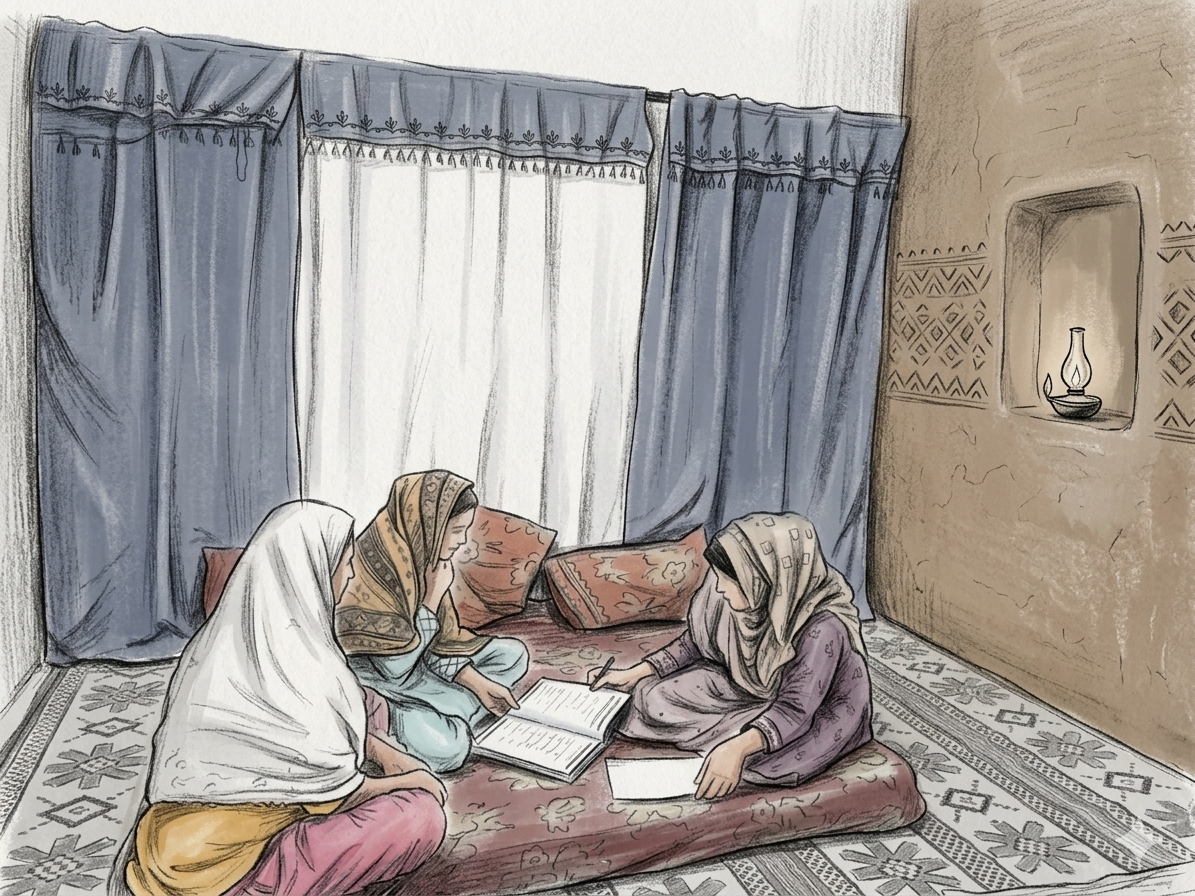
Education is delivered where girls feel safest at home or within walking distance.
Devotees
Locally recruited and trained female educators provide direct one-to-one mentorship to knowledge seekers.
Knowledge Points
Knowledge Points are community-based learning hubs: a safe study space for knowledge seekers.
Transition from Matric to Intermediate – where EBB focuses on.
In Pakistan, education runs in two stages. Girls complete secondary school through Matric (Grade 10), then move on to Intermediate (Grades 11–12), what’s called HSC. The transition from Matric to Intermediate is where most girls in rural Sindh disappear from the system.
What most families don’t know and what EBB works with is that board exams can be sat as a private candidate. No daily travel to college. No mixed-gender campus. Just structured study, a registered exam seat, and a result that counts.
That’s the gap EBB fills. We support girls through the curriculum, cover their exam fees and registration, and make sure the answer to “can I keep studying?” is yes.
Learning is only half of it.
For Knowledge Seekers who want to build something of their own, EBB offers a one-time startup grant, practical training, and an advisor who’s done it herself.